
Note: This teardown and analysis are intended solely for educational and technical exploration. It is not an attempt to discourage anyone from purchasing the product. Hardware design involves trade-offs, and this represents one technical perspective on those decisions and how the hardware fits into the wider Pocket service.
This post did not start with a purchase, but with a gift. A friend pre-ordered the Pocket AI recorder and, after it arrived, they decided to gift it to me.
Since I work on several microcontroller projects, my curiosity quickly took over. I wanted to understand what was inside this unusually slim recorder and how much of the advertised experience the hardware itself handled.
The advertised 64 GB of storage
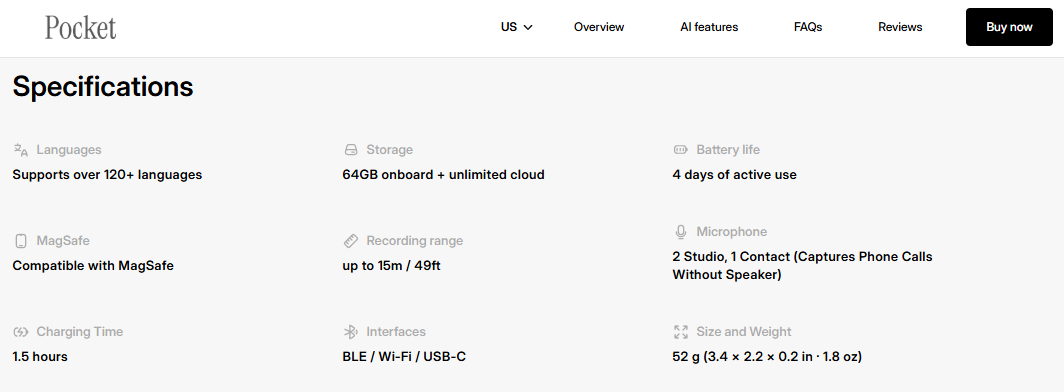
According to the official specifications on the Hey Pocket website, the device features 64 GB of onboard storage.
Opening the device confirmed that it contains dedicated eMMC storage. The package appears to be marked EMMC128-TY29, although part of the marking is covered by a production label.
The presence of eMMC confirms that this is not simply a microphone continuously streaming everything to a phone. The recorder has hardware capable of storing audio locally.
I was not able to inspect the eMMC identification data, filesystem, or partition layout, so I cannot independently verify its raw or usable capacity. The 128 in the package marking should not be interpreted as a capacity without confirming the manufacturer’s part-number format.
The safest conclusion is that Pocket contains dedicated local storage, while the exact relationship between the physical eMMC capacity and the advertised 64 GB remains unverified.
Measuring the Hardware
When I opened the case, I was struck by how small the board actually is. The internal PCB measures approximately 5.5 cm wide and slightly less than 3 cm tall. The battery occupies most of the enclosure, not the main electronics.
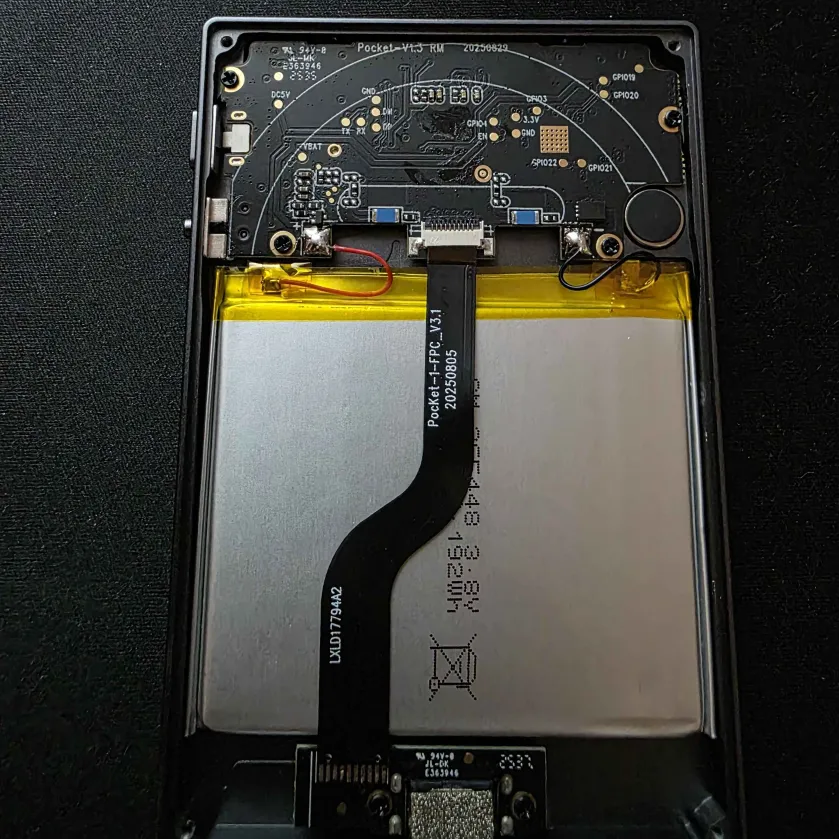
The board is compact but includes separate components for storage, firmware, wireless communication, and audio processing.
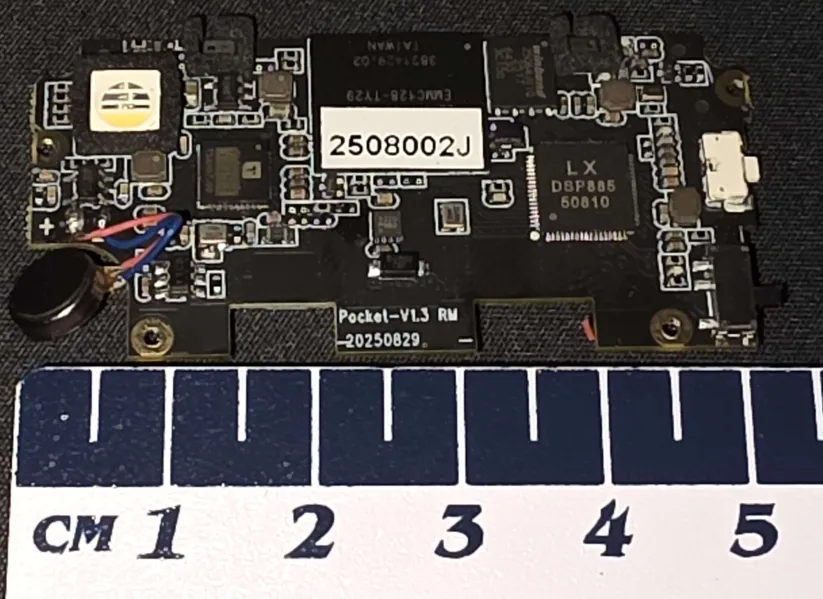
The PCB Breakdown: What's Actually Inside?
Through my teardown, I identified four primary components:
| Component | Probable function |
|---|---|
Kingston EMMC128-TY29 |
Dedicated eMMC storage. Its exact capacity and partition layout were not verified. |
| Telink-marked controller | Likely manages Bluetooth communication and general device coordination. The exact model remains unconfirmed. |
Lyncic LX DBP805 60810 |
Appears to handle audio acquisition or processing. |
Winbond 25Q64JV |
A confirmed 64-megabit, or 8 MiB, serial NOR flash chip likely used for firmware or configuration. |
| RGBW SMD LED | Multi-color status indicator used to communicate device state. |
Diagnostic and programming access
The PCB includes exposed factory test pads labeled:
- TX and RX
- GND
- USB DP and DN
- EN
- 3.3 V
- GPIO4
- GPIO19
- GPIO20
- GPIO21
- GPIO22
These pads were likely used during manufacturing, programming or board-level diagnostics.
I connected the recorder to a Windows computer using a known-good USB data cable. In its normal operating state, it did not enumerate as:
- A USB storage device
- A serial port
- A portable media device
- An unknown USB device
This suggests that the external USB connection primarily functions as a charging interface during ordinary use. The exposed TX/RX and USB DP/DN test pads indicate that factory-level data access may exist separately from the external connector.
I considered probing the UART interface, but doing so would require soldering or holding a wire against very small test pads. Given the uncertain processor and programming protocol, the effort outweighed the likely value of continuing the reverse-engineering process.
The Battery
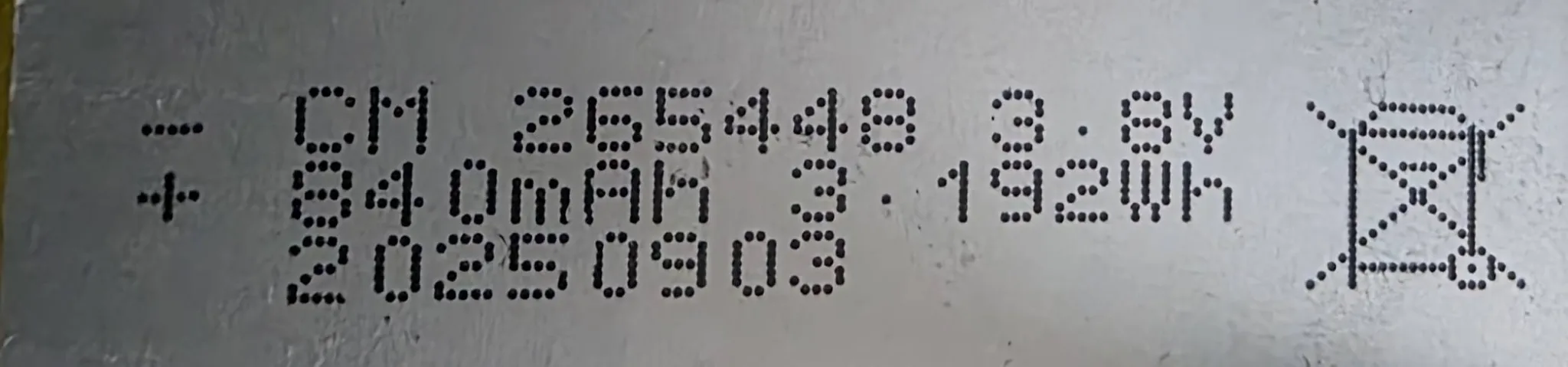
The battery is marked:
- 3.8 V nominal
- 840 mAh
- 3.192 Wh
- Cell code
265448
The battery occupies substantially more internal space than the PCB, which helps explain how the device maintains its slim shape while providing useful recording time.
Offline recording
The presence of dedicated eMMC makes local recording or buffering technically plausible. Pocket therefore has the hardware required to retain audio without continuously streaming it to the phone.
I did not perform a controlled test with the phone powered off or outside Bluetooth range, so I cannot confirm exactly how offline recordings are stored and synchronized.
The teardown establishes that the hardware contains local storage. The precise division of work between the recorder and companion app requires behavioral or software-level testing.
Where the "AI" runs
The internal hardware resembles a conventional connected audio recorder:
- Microphones capture audio.
- A dedicated IC handles the audio path.
- Serial flash stores firmware or configuration.
- eMMC provides local storage.
- A wireless controller communicates with the phone.
I found no identifiable hardware dedicated to running large transcription or generative-AI models locally. Pocket’s documented workflow and app screenshots also place transcription, summarization, and other AI features within the companion-app and subscription-service experience.
The recorder therefore acts as the specialized hardware front end of a larger platform. It captures audio, stores it locally, and communicates with the phone. The phone provides the primary user interface and synchronization layer, while Pocket’s cloud services provide the more computationally intensive AI features.
The requirement to use the same email address associated with the purchase is consistent with an account-bound service and subscription model.
Final thoughts
Pocket is best understood as a connected digital recorder that serves as the input device for a phone-and-cloud AI platform, rather than as a self-contained AI notes assistant.
That does not make the hardware unnecessary. A thin, dedicated recorder can be more convenient than reaching for a phone, and the local eMMC suggests that the device performs meaningful capture and storage functions independently.
However, the teardown illustrates a broader pattern in consumer AI hardware: the physical product often handles sensing, storage, and connectivity, while much of the advertised intelligence exists in the companion software and remote services.
Customers are therefore buying more than hardware. They are also buying access to an ecosystem consisting of the recorder device, mobile companion app, and subscription-backed cloud functionality.
I did not evaluate the app or subscription plans deeply enough to review their quality. This teardown focuses on the physical design and the apparent division of responsibilities between the recorder, phone, and cloud.
Additional consumer experiences can be found through the Pocket community on Reddit and other published reviews.